1
Amazon for
Automotive
Built for Automotive AI
2
3
4
5
6
7
8


Manufacturing
Manufacturing
Faucibus ut morbi molestie duis aliquet turpis ullamcorper arcu odio. Ut ridiculus
elementum.
Manufacturing
Complete!

Autonomous Driving on AWS
Press ReleasePowering the next generation of autonomous trucks with Aurora AWS and AUMOVIO are helping Aurora scale autonomous trucks for production by 2027. This collaboration addresses one of the industry's biggest challenges: making sense of massive amounts of data generated by self-driving vehicles. Modern autonomous vehicles capture millions of road scenarios, driver behaviors, and safety situations every day. Processing this information quickly and accurately is critical to building vehicles that can navigate safely in any condition. AUMOVIO's deep automotive technology expertise combined with advanced cloud infrastructure and AI capabilities from AWS helps create scalable solutions that rapidly process this flood of data, identifying critical safety patterns and accelerating improvements that would traditionally take years. The breakthrough lies in how engineers process and interact with this data. With AI, instead of spending weeks manually searching through millions of driving scenarios, they can now ask questions in plain language, like "show me all cases where pedestrians entered the roadway at night in rain," and get instant results. AI helps to quickly surface critical safety scenarios and rare edge cases, freeing engineers to focus on development rather than data management. The new solution will be used for the first time in a significant customer project: deploying autonomous trucks at scale. AUMOVIO has teamed up with Aurora – who became the first company to deploy driverless trucks in the U.S. earlier last year – to jointly develop and manufacture a highly-industrialized scalable generation of its Aurora Driver hardware with Start of Production planned for 2027. AUMOVIO will provide an industrialized fallback system, which is a specialized secondary computer that can take over operation if a failure occurs on the primary Aurora Driver system.
NVIDIA
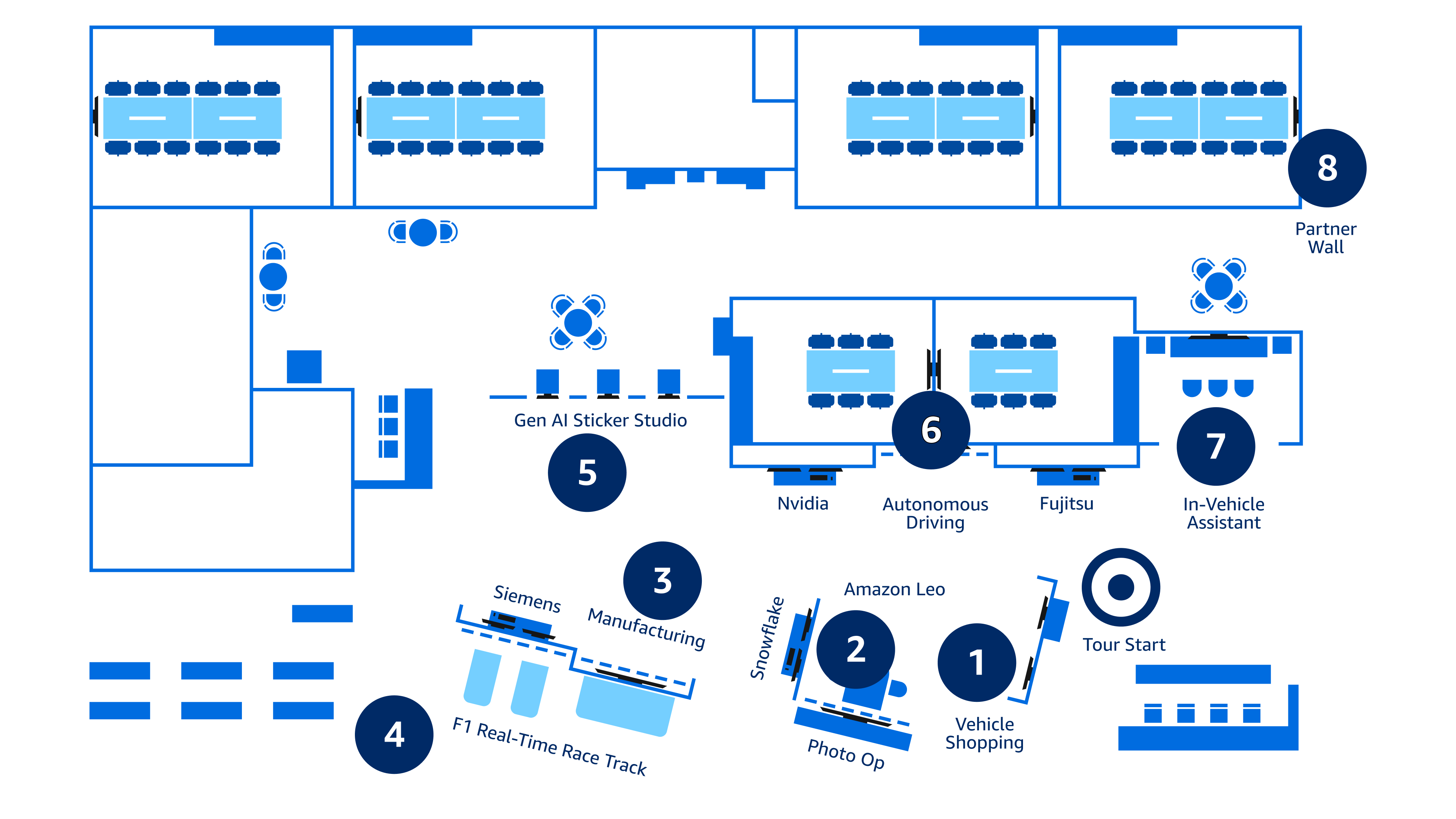
https://www.nvidia.com/en-us/ai/cosmos/Accelerating Autonomy with NVIDIA Cosmos NVIDIA is accelerating autonomous vehicle (AV) development using Omniverse and Cosmos powered by AWS. Both Omniverse and Cosmos are available today on the AWS Marketplace and together, these AWS-enabled capabilities help autonomous vehicles to learn, adapt, and drive more intelligently while advancing safer mobility solutions. The solutions use three key AI-driven methods: 1/Model Distillation transfers driving knowledge from a complex "teacher" AI model to a smaller, faster "student" model that can run efficiently in vehicles, enabling real-time decision-making while maintaining near-teacher-level performance. 2/Closed-Loop Training converts real-world driving logs into 3D simulated environments using Omniverse's neural reconstruction, where AI models are tested across scenario variations, evaluated by Cosmos, and refined through large-scale training datasets to handle complex driving situations more robustly. 3/Synthetic Data Generation creates diverse 4D driving environments from log data by building digital twins of real-world scenarios, with Cosmos generating accurate variations that close the simulation-to-reality gap and scale training data effectively.
Fujitsu
https://global.fujitsu/en-global/offering/ev-shiftAI-Powered SDV: Mobility’s New Potential Fujitsu showcases how connected vehicles can help improve both road safety and lead to safer city planning by highlighting an integrated three-phase solution that transforms vehicle data into actionable insights. Phase 1 the solution starts by using AI to automatically detect security risks in vehicle software, helping cars get safer OTA updates faster – a critical foundation for autonomous vehicle software management. Phase 2 shows mobile sensors built using AWS Lambda, which collect data about road conditions and infrastructure wear as the vehicle drives. This connected vehicle approach helps reduce manual inspections and feeds the continuous data streams that AV systems require, while helping cities plan repairs more efficiently. Phase 3 shows how real-world driving data feeds into a digital twin of the city, powered by Amazon Aurora and Amazon Elastic Kubernetes Service (Amazon EKS), allowing transportation planners and local governments to test solutions before implementing them. For example, reducing traffic congestion, improving emergency response times, and making daily commutes shorter and more reliable, shortening the path from development to real-world autonomous operations.
In-vehicle assistants on Amazon
https://www.aboutamazon.com/news/devices/alexa-plus-bmw-voice-assistantSophisticated control using natural language Experience the next generation of in-vehicle assistants powered by Alexa+ and custom AI agents on AWS, delivered through Panasonic’s SkipGen technology. By combining Alexa’s generational investments in voice technology with the scalability, resiliency, and global infrastructure of AWS, automakers can deliver a fully functional, conversational assistant out of the box, while retaining the flexibility to customize, extend, and differentiate the experience. Inside the vehicle, natural language becomes the primary interface, enabling sophisticated interactions that span navigation, entertainment, vehicle controls, connected home, and communication. Custom AI agents built on AWS support key moments across the ownership lifecycle, from guided vehicle onboarding to proactive maintenance and service scheduling. These custom agents work alongside Alexa Custom Assistant (ACA), allowing automakers to layer brand-specific intelligence and workflows on top of a proven voice foundation. With Amazon, automakers can accelerate development and deliver seamless in-vehicle experiences at scale, combining rapid time to market, global reach, and enterprise-grade security with the freedom to innovate experiences over time. Unmatched flexibility. AWS provides the flexibility to develop and deploy software the way you need, from virtualized ECUs to AI–powered workflows. Automakers have control over their vehicle technology stack, from the OS and embedded systems to mapping solutions and applications. Trusted partners and solutions. Connect with 40+ specialized AWS Partners with key competencies, integrate AWS Partner development tools through Amazon Marketplace, and benefit from proven automotive architectures and solution guidance built from decades of experience. Most capable AI and cloud infrastructure. AWS delivers the broadest and deepest set of AI and cloud capabilities with the world's largest global footprint, designed to help meet the demanding requirements of automotive workloads. From training and deploying AI models to running vehicle development, testing, and production environments, AWS provides the most secure, scalable, and resilient infrastructure, helping ensure millions of connected vehicles and AI-powered assistants operate reliably worldwide.
Manufacturing on AWS
https://www.aboutamazon.com/news/operations/amazon-robotics-robots-fulfillment-centerPhysical AI for adaptive automotive manufacturing This demo brings physical AI to life through a hands-on automotive manufacturing scenario inspired by Amazon Robotics’ intelligent object picking, Amazon’s Blue Jay work in flexible assembly automation, and Project Eluna’s use of agentic AI to support faster, more informed operator decisions. At the center of the experience is a collaborative robot (cobot) performing adaptive picking, handling, and sorting of steel plates with multiple shapes, weights, and surface variations, mirroring the variability automakers face every day on the factory floor. In simple terms, physical AI is the application of artificial intelligence to machines that can see, sense, reason, and act in the real world. Unlike traditional automation that relies on rigid programming and fixed conditions, physical AI enables robots to adapt to change, learn from data, and make decisions in dynamic environments. In a manufacturing context, this can look like a robot using vision and sensor data to recognize a misaligned or unfamiliar part on a conveyor, determine the best way to grasp it, and adjust its motion in real-time, without stopping the line or requiring manual reprogramming. For automotive manufacturers under pressure to increase flexibility, reduce downtime, and improve quality, this represents a fundamental shift in how automation is designed and deployed. The demo illustrates five core pillars that define how physical AI is transforming automotive and industrial operations. It begins with data collection and preparation, capturing sensor, vision, and operational data as the foundation for intelligent decision-making. Training builds robust AI models capable of handling real-world variability. Simulation enables extensive virtual testing of scenarios before deploying to physical systems. Sim2Real bridges digital and physical environments, allowing insights learned in simulation to transfer safely to production. Finally, agentic orchestration coordinates complex workflows through parallel task execution and distributed workloads across robots, systems, and operators. Together, these pillars show how automakers can move beyond fixed automation toward adaptive, scalable, and software-defined manufacturing systems—unlocking greater resilience, speed, and operational intelligence across the factory floor.
Siemens
https://xcelerator.siemens.com/The Future of Industrial Innovation Siemens showcases the future of industrial innovation by bringing its Industrial Metaverse vision to life, demonstrating how connected software, digital twins, and AI-driven automation enable manufacturers to design, simulate, and operate smarter, more resilient production systems. PepsiCo Industrial Metaverse - Siemens showcases how digital twins—virtual replicas of real-world facilities—can transform industrial operations. Using three PepsiCo facilities as a live example (bottling plants, shipping centers, and distribution hubs), the demo presents photorealistic 3D visualizations powered by NVIDIA Omniverse. You can interact with these virtual environments through an AI-powered chatbot built on Amazon Bedrock and AgentCore, asking questions and exploring facility operations in real-time. This solution demonstrates how companies can simulate and optimize their operations before making costly real-world changes, ultimately improving efficiency and sustainability across manufacturing and supply chain networks. Siemens Xcelerator - Siemens Xcelerator is a comprehensive digital transformation platform that supports the entire automotive engineering value chain—from design through prototyping to production—enabling engineers to optimize vehicle designs from day one with advanced simulations and digital twin solutions that make cars lighter, more efficient, and more sustainable. The platform creates an open environment by combining Siemens' industrial expertise and integrating AWS AI capabilities into key solutions such as Teamcenter and the Mendix low-code platform to make it easier for businesses of all sizes and industries to build and scale AI applications. With flexible, scalable, next-generation SaaS solutions powered by Siemens and AWS, companies can unlock innovation, empowered to not just build vehicles but to fundamentally shape the future of mobility.
Snowflake
https://www.snowflake.com/en/Driving the Future of Manufacturing Snowflake showcases a comprehensive three-tier industrial AI solution that demonstrates the complete journey from raw manufacturing data to intelligent, actionable insights to improve equipment performance and efficiency. Together, these three integrated layers illustrate Snowflake's vision for modern smart manufacturing: using data to prevent costly downtime, improving equipment efficiency, and making data-driven decisions in real-time. Phase 1 shows programmable logic controllers (PLCs) streaming real-time operational data directly into Snowflake's data platform, creating a virtual shop floor environment where visitors can observe various equipment performance degradation scenarios as they unfold in real-time. Phase 2 features a low-code interface that provides visualization of the ongoing shop floor performance, where predictive algorithms continuously analyze the incoming data streams to identify equipment degradation patterns, generate proactive alerts, and recommend specific corrective actions before failures occur. Phase 3 will have a conversational AI agent that actively monitors the entire simulation, offering attendees a natural language interface to interact with the system. This AI agent possesses full contextual awareness of the simulation state and can intelligently suggest different intervention strategies based on evolving scenarios, demonstrating how manufacturers can leverage AI-powered decision support to optimize operations.
Amazon Autos
https://www.amazon.com/amazon-autos-where-to-buy-cars-online/b?ie=UTF8&node=212438745011Seamless Shopping, from Couch to Car Lot Amazon Autos is rethinking the vehicle shopping journey from end to end. The demo walks through a real-world scenario in which customers browse available vehicles from local dealerships, evaluate trade-in value, configure financing, and choose between lease or purchase options, all within a familiar Amazon shopping experience. Customers can now use Amazon Autos to shop across multiple brands, including Hyundai and Certified Pre-Owned Ford vehicles, while accessing an expanded lender network and a new “Sell My Car” feature that provides a guaranteed value offer with no purchase obligation. Customers can complete nearly the entire transaction remotely—selecting financing or lease options, securing trade-in value, and finalizing purchase details—before choosing a preferred date and time for vehicle pickup. By the time customers arrive at the dealership, the experience is streamlined to a short visit focused on final paperwork and vehicle inspection, typically taking about 30 minutes. For dealerships and manufacturers (OEMs), Amazon Autos drives value by enabling completed digital transactions. Dealers see real-world outcomes, with higher conversion rates, improved sales efficiency, and reduced operational friction. Dealers and OEMs maintain full control over brand presentation, pricing, and inventory while gaining access to Amazon’s broad customer reach and trusted shopping experience.
Amazon Leo
https://leo.amazon.com/Beyond the reach of traditional networks Amazon Leo is building a satellite network designed to extend high-speed, reliable connectivity to vehicles and equipment wherever they operate. Leo combines specialized satellite hardware with flexible service models to support the next generation of connected automotive and industrial systems. Built on AWS global infrastructure, Amazon Leo uses the same enterprise-grade cloud services trusted by millions of customers worldwide. Integrated compute, networking, and edge capabilities enable low-latency operations, resilient ground connectivity, and seamless global scale, creating a foundation for always-on vehicle connectivity beyond the reach of traditional networks. Together, these capabilities position Amazon Leo as a single, global connectivity layer for land mobility, helping manufacturers and fleet operators turn vehicles into intelligent, connected assets and enabling safer, more efficient operations across the world.